Persecution and paranoia
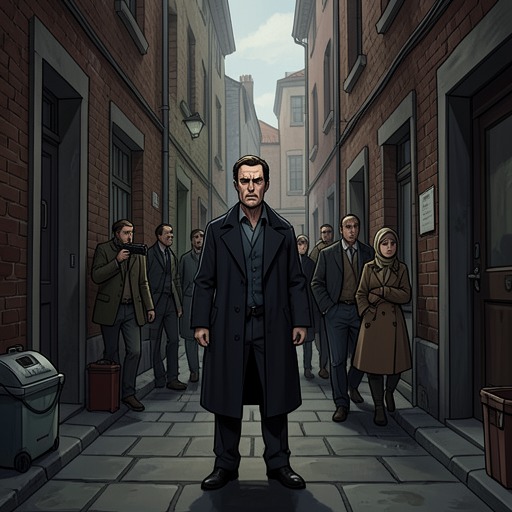
The DoublePersecution and paranoia are the pattern through which Yakov Petrovitch Golyadkin interprets danger, humiliation, and other people’s conduct. His conviction that enemies are working against him intensifies after a social disgrace, follows him into the government office, and culminates in his belief that colleagues have united against him. The narrative makes that belief both a source of real distress and a doubtful explanation of what he sees: readers encounter events alongside Golyadkin’s agitated interpretations, without a simple confirmation that every suspected plot exists as he imagines it.
The conviction of hidden enemies
The pattern is explicit when Golyadkin tells Krestyan Ivanovitch Rutenspitz, in a frightened whisper, that he has enemies who have sworn to ruin him. The doctor tries to calm him and repeatedly urges him to sit down, but Golyadkin keeps his eyes fixed on him while the doctor paces in displeasure. The exchange establishes a basic tension: Golyadkin experiences himself as threatened, while the person hearing him responds as though the talk of enemies is itself something to contain.
After a severe humiliation at Olsufy Ivanovitch’s house, that sense of danger becomes nearly all-consuming. Golyadkin hurries alone through a November storm along Fontanka Quay, trying to reach his flat on the fourth floor of a building on Shestilavotchny Street. The weather appears to join his imagined persecution, but the account gives the more immediate cause of his distress as the shock of what has happened at the house. He scarcely registers the storm or his surroundings; he even loses a golosh in the snow and slush without noticing.
His movements express a wish to escape not just a place but himself. He stops stock-still, then runs on without looking back, as though pursued; at the railing beside the canal, he is exhausted and momentarily forgets where he is going. The narration describes him as wanting to disappear, while his attention remains fixed on the humiliation he has just suffered. The storm therefore does not simply provide a hostile setting: it accompanies a state in which external discomfort has become secondary to shame and fear.
Reading strangers and colleagues as signs
At the canal, Golyadkin thinks he senses someone beside him, though no one is there. Soon after, he sees a belated passer-by and becomes troubled by the possibility that the stranger is not incidental but has an object in crossing his path. The thought is presented tentatively: the narration allows that Golyadkin may have felt only a vague suspicion rather than reasoned it out fully. The stranger is dressed like him and walks with similarly quick, anxious steps, but the encounter itself does not establish that the figure is an enemy. Its uncertainty is the point: resemblance and coincidence become charged with menace.
The same interpretive habit follows Golyadkin into the department. Though he vows to avoid anything that might draw attention to the previous evening, he furtively studies his colleagues’ faces for some new sign directed at him. He assumes that what happened yesterday must be connected to what surrounds him now, and longs for some event—even a calamity—to end his uncertainty. Instead of easing his suspicion, ordinary proximity becomes material for it: the possibility of a concealed meaning troubles him more than any particular annoyance.
When colleagues continue working and His Excellency says nothing, Golyadkin briefly treats their apparent lack of response as reassuring evidence that the matter may have come to nothing. He welcomes the scene as a turn for the better, yet cannot settle on a stable judgment of the people around him. He distrusts Anton Antonovitch despite taking comfort from his apparent good nature, and blames Andrey Filippovitch for seeming to interfere and remain on his track. His interpretation swings between relief and suspicion without resolving the contradiction.
Public humiliation and conspiracy
The appearance of Golyadkin’s double at the department turns his private unease into a public confrontation. Golyadkin recognizes the newcomer before looking fully at him, grows hot with shame, and buries his head in his papers. Later, when the double approaches the door, Golyadkin rushes at him and catches him by the sleeve. The clerks step back to watch. Golyadkin interprets their presence as evidence that public opinion is against him and that others are intriguing against him; the gathering that witnesses his action is thus already folded into his suspicion.
The confrontation ends with the double adopting an official manner, claiming to be on a special commission, and leaving for the next room. Golyadkin reads the exit as treacherous insult and public disgrace, then starts after him before turning back because he sees that pursuit would be useless. He tells himself that they all stand together and set one another on against him. The thought turns an individual conflict into a general conspiracy, even as his own account of the scene is shaped by his shame at having been watched.
After returning to his chair, Golyadkin declares inwardly that his opponent will not escape and that he will eventually be caught. He stabs his pen into the inkstand and begins writing furiously, resolving to act despite not knowing what action to take. The episode shows paranoia not only as fear but as a pressure toward response: uncertainty becomes a promise of pursuit and retaliation, though the immediate plan remains undefined.
Narrative ambiguity and significance
The novel repeatedly places Golyadkin’s suspicions beside observable details without making them identical. The passer-by resembles him, but the encounter does not prove a plot; colleagues are at work, but he searches their faces for concealed references; the clerks watch a confrontation, and he takes their attention as confirmation that they oppose him. This arrangement keeps the reader close to his distress while preserving distance from his conclusions. His fear is unmistakable; the full extent of the alleged conspiracy is not established by these scenes.
That tension is especially sharp in his repeated shifts between self-soothing and alarm. He comforts himself with the prospect that events may turn out for the best, and at the office interprets silence as a sign that nothing serious has happened. Yet neither reassurance lasts: suspicion returns in the form of a threatening stranger, watchful colleagues, and a united group of supposed enemies. Persecution and paranoia thus organize the novel’s movement from private humiliation to public conflict, making the social world appear at once ordinary in its visible actions and ominously charged in Golyadkin’s perception.